8 Best Eventbrite Alternatives & Competitors for 2026 (Real Pricing)
-
 by
by

If you are looking for Eventbrite alternatives or Eventbrite competitors, you probably have a specific problem: the fees feel too high, or the platform does not fit how you actually run events.
This guide compares the most common Eventbrite alternatives organizers consider in 2026, with real per-ticket pricing for each.
Eventbrite alternatives and competitors at a glance
Here is the quick comparison of per-ticket pricing on each platform’s most popular plan. Pricing was current at time of writing. Always confirm on the provider’s pricing page before deciding.
SimpleTix
– Per-ticket fee: $0.79 + 2%
– Processing: Handled by your connected Stripe, Square, or PayPal account at their standard rates
– Free events: No fees
– Contract / subscription: None required
– On a $20 ticket: $1.19 in platform fees (5.95%)
Eventbrite (Flex plan)
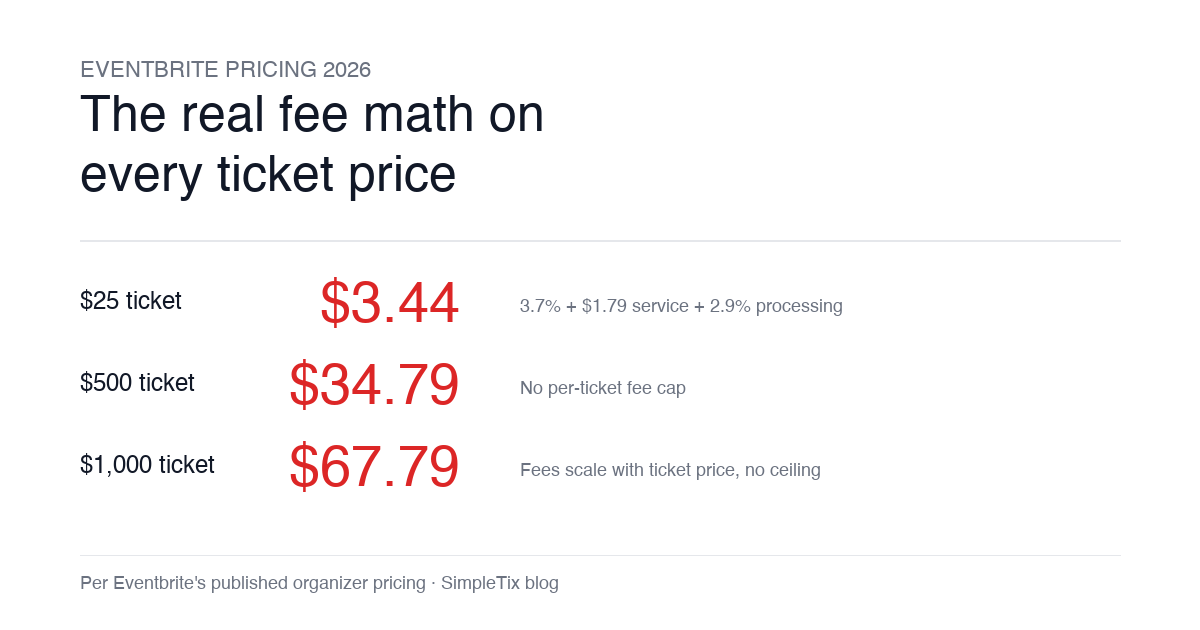
– Per-ticket fee: 3.7% + $1.79
– Processing: 2.9%
– Free events: Free to list
– Contract / subscription: Flex is pay-as-you-go; Pro and Premium plans available for higher volume
– On a $20 ticket: $3.11 in fees (15.5%)
TicketSpice
– Per-ticket fee: $0.99 flat per ticket
– Processing: 2.99% via their payment processor, or pass-through if using your own
– Free events: Free to list
– Contract / subscription: None required
– On a $20 ticket: $0.99 + processing
Ticket Tailor
– Per-ticket fee: $0.79 per ticket (pay-as-you-go plan)
– Processing: Via your Stripe, PayPal, or Square account at their standard rates
– Free events: Free to list
– Contract / subscription: Monthly subscription plans also available
– On a $20 ticket: $0.79 + your processor’s rate
TicketLeap
– Per-ticket fee: $1.00 + 2% per ticket
– Processing: ~3% via included Stripe/PayPal
– Free events: Free to list
– Contract / subscription: None required
– On a $20 ticket: ~$1.40 + processing
The takeaway: SimpleTix, TicketSpice, and Ticket Tailor sit at the low-cost end of the market. TicketLeap is in the middle. Eventbrite Flex is the most expensive of the group on a typical paid ticket.
What to look for in an Eventbrite alternative
Pricing matters, but it is not the whole picture. For most organizers, picking an Eventbrite alternative comes down to five things.
1. Fees that don’t eat your margin
If you run low-cost tickets, fundraisers, seasonal events, or family attractions, fees add up fast. A platform can look fine on paper and still become expensive once volume picks up.
SimpleTix keeps pricing straightforward: $0.79 + 2% per ticket, with no contracts, no subscriptions, and no fees on free events. You can also pass fees to attendees or absorb them yourself.
2. Ticketing that fits how you run events
You may need more than basic general admission tickets: timed entry, reserved seating, memberships, season passes, promo bundles, or waivers.
That is where differences between Eventbrite alternatives start to show. Some are built around simpler setups. Others are better suited for venues, attractions, or recurring programs.
3. Easy check-in for staff
On event day, check-in needs to be simple. Fast scanning, offline mode, and clear staff permissions can make operations smoother.
4. Tools for in-person sales
If you sell at the gate, box office, or front desk, you will want to know whether the platform supports that workflow cleanly.
5. Tools that fit your business model
A brewery has different needs than a theater. A farm with timed fall entry has different needs than a nonprofit gala.
The best Eventbrite alternative is usually the one that fits your day-to-day workflow, not the one with the flashiest homepage.
SimpleTix: best for organizers who need operational flexibility
SimpleTix is a good fit for teams that run more than basic ticket sales.
It is especially useful for teams that need timed entry, reserved seating, memberships, season tickets, box office sales, waivers, promo offers, and recurring events.
Where SimpleTix wins
- Predictable pricing. $0.79 + 2% per ticket. No contracts, no subscriptions, no fees on free events.
- Works for more than one event format. General admission, timed entry, reserved seating, season tickets, and Flex Passes with attendee photo verification.
- Strong fit for in-person operations. The SimpleTix Organizer app supports check-in on iOS and Android, includes offline scanning mode, and offers scan-only mode for staff. Ticket printing from the mobile app is supported.
- Useful payment options. Integrates with Stripe and Square, supports PayPal and Venmo checkout, offers same-day payouts.
- Marketing tools built in. Automated reminder emails, email blasts, abandoned cart recovery emails, promo codes, BOGO offers, quantity discounts, and conversion tracking with Google and Facebook pixels.
Where SimpleTix might not be your pick
- If you need a heavy-weight enterprise event platform with dedicated account management, Cvent or a similar enterprise tool may fit better.
- If your event is purely virtual or hybrid with complex networking, Whova or Bizzabo are more conference-focused.
- If you sell only a handful of free RSVPs per year, almost any free option works.
Best use cases for SimpleTix
- Venues that need reserved seating or season tickets
- Farms and attractions that need timed entry and capacity control
- Food and drink events using Square for POS or upsells
- Community events and nonprofits that want free event ticketing without platform fees
- Organizations with staff teams that need permissions, reporting, and box office tools
SimpleTix also supports memberships, including one-time and recurring memberships, tiered levels, member-only pricing, and complimentary tickets. That matters if you run a museum, theater, club, or community organization with repeat attendees.
TicketSpice: best for organizers who want a flat per-ticket fee
TicketSpice is one of the most-mentioned Eventbrite alternatives, especially among organizers who want simple, predictable pricing without a percentage component.
Where TicketSpice wins
- Flat $0.99 per ticket regardless of ticket price. This is especially favorable for high-priced tickets ($50+) where percentage-based fees on other platforms add up.
- Strong custom registration form builder
- Webconnex ecosystem includes adjacent tools like donation forms
Where some organizers may want more
- The percentage-free pricing flips against you on low-priced tickets. A $5 ticket on TicketSpice ($0.99) is more expensive than the same ticket on SimpleTix ($0.79 + $0.10 = $0.89).
- Less depth around timed-entry attractions, memberships, and box office operations than SimpleTix
- Webconnex’s payment processor is the default; using your own may require extra setup
Ticket Tailor: best for straightforward ticketing at low volume
Ticket Tailor is a popular Eventbrite alternative for organizers with simpler needs. The brand is well-regarded for clean checkout and a flexible payment model.
Where Ticket Tailor wins
- $0.79 per ticket on the pay-as-you-go plan, no percentage
- Connects directly to your Stripe, PayPal, or Square account so processing is at your existing rates
- Strong reputation for customer support
- Good for organizers selling internationally
Where some organizers may want more
- Lighter on attractions/farm-specific features like timed entry capacity control and Flex Passes
- Reserved seating exists but is less mature than SimpleTix or specialized venue tools
- Box office and on-site sales workflows are less robust
TicketLeap: best for community and grassroots events
TicketLeap has been around a long time and is a common Eventbrite alternative for community events, schools, and grassroots organizations.
Where TicketLeap wins
- Clean, simple event setup
- Decent base feature set for non-technical organizers
- No subscription required
Where some organizers may want more
- $1.00 + 2% per ticket is more expensive than SimpleTix, TicketSpice, or Ticket Tailor
- Limited capabilities around reserved seating, memberships, and timed entry
- Less active product development relative to competitors
Other Eventbrite alternatives worth knowing about
These are not full reviews, but they come up often enough in organizer searches that they are worth mentioning.
- Brown Paper Tickets — long-running independent ticketing platform. $1.25 + 3.5% per ticket. Popular with arts and nonprofits.
- Universe (owned by Ticketmaster) — 2% + $0.99 service fee. Smaller venue and concert focus.
- Bookwhen — subscription-based pricing, strong for recurring classes and workshops.
- Brushfire — popular with churches and faith-based organizations, strong group ticketing features.
- Yapsody — flat per-ticket fees, decent feature set for small venues.
If you are running an enterprise-scale program, the comparison set shifts toward Cvent, Bizzabo, Whova, and RegFox. Those are not direct Eventbrite alternatives so much as different-category tools.
Which Eventbrite alternative makes sense by organizer type?
Here is the practical version.
For venues
If you run a theater, comedy club, live music space, or performing arts venue, you will care about reserved seating, season tickets, box office sales, and staff permissions.
Strong picks: SimpleTix for reserved seating + memberships + season tickets. TicketSpice if you sell mostly higher-priced tickets and want flat fees.
For farms and timed-entry attractions
If you manage pumpkin patches, holiday light events, haunted attractions, museums, or other capacity-based admissions, you need timed entry, capacity management, and fast scanning at the gate.
Strong pick: SimpleTix is built for this workflow. The Organizer app handles offline scanning and capacity-controlled timed entry.
For food and drink events
Breweries, wineries, distilleries, and restaurants often need a mix of ticketing and on-site sales. If you already use Square, that connection matters.
Strong pick: SimpleTix, especially for operators using Square POS, gift cards, or catalog upsells, including Tap to Pay on iPhone for contactless payments.
For community events and nonprofits
If you run free events, fundraisers, school programs, or community gatherings, platform fees can be hard to justify.
Strong picks: SimpleTix (no fees on free events, no subscription). Brushfire or TicketLeap also worth a look for grassroots community use.
For simple one-off events
If you run occasional workshops, classes, or small paid events and do not need advanced tools, several Eventbrite alternatives work.
Strong picks: Ticket Tailor or SimpleTix for pay-as-you-go simplicity. Bookwhen if you run recurring classes on a fixed schedule.
For conferences and B2B events
If you run multi-track conferences with networking, sponsor management, and complex agendas, the comparison set is different.
Strong picks: Whova, Cvent, or Bizzabo are more purpose-built for this. SimpleTix is not optimized for this use case.
A quick comparison checklist
If you are narrowing down your Eventbrite alternatives, work through this list:
- What will this actually cost per ticket given your average price?
- Can I pass fees to attendees if I want to?
- Does it support the event types I run now and next year?
- Can my staff check people in easily from a phone?
- Does it work offline if service is bad?
- Can I sell in person at the box office or gate?
- Does it connect with Stripe, Square, or my email tools?
- Does it charge anything for free events?
Frequently asked questions about Eventbrite alternatives
What is the cheapest Eventbrite alternative?
For most ticket prices, SimpleTix and Ticket Tailor are the cheapest Eventbrite alternatives at $0.79 per ticket. TicketSpice at $0.99 flat can be cheaper for higher-priced tickets where SimpleTix’s 2% adds more.
What is the best free alternative to Eventbrite?
All major Eventbrite alternatives, including SimpleTix, TicketSpice, Ticket Tailor, and TicketLeap, allow free events with no platform fees. Eventbrite itself also charges no fees on free events.
Which Eventbrite competitor has the lowest fees?
SimpleTix at $0.79 + 2% is among the lowest. Ticket Tailor at $0.79 per ticket and TicketSpice at $0.99 per ticket are also low-fee options. Eventbrite Flex at 3.7% + $1.79 + 2.9% processing is the most expensive of the major platforms.
Are there free Eventbrite alternatives?
There are no major Eventbrite alternatives that are fully free for paid ticketing. All charge per-ticket or processing fees. Most, including SimpleTix, are free for free events.
What is the best Eventbrite alternative for small events?
For small events, the cheapest options are usually SimpleTix, Ticket Tailor, and TicketSpice. Pick based on whether you also need features like reserved seating (SimpleTix), simplicity (Ticket Tailor), or flat fees (TicketSpice).
What is the best Eventbrite alternative for nonprofits?
SimpleTix is a strong fit for nonprofits because there are no fees on free events, no subscription required, and the platform supports fundraising-style event configurations. Brushfire is also popular with faith-based nonprofits.
The bottom line
If you are evaluating Eventbrite alternatives for 2026, the realistic shortlist is SimpleTix, TicketSpice, Ticket Tailor, and TicketLeap, with Brown Paper Tickets, Universe, Bookwhen, and Brushfire as adjacent options depending on your event type.
If you need timed entry, reserved seating, memberships, season tickets, box office sales, waivers, and in-person sales in one platform, SimpleTix covers the most ground at the lowest predictable cost. Compare it on your own event volumes here: SimpleTix pricing.
Latest News
Related Articles

Season Ticket Software for Fall 2026: Subscriptions, Reserved Seating & Renewals
-
by
Fall subscription sales are the single biggest revenue moment for most performing arts organizations. Season packages, member renewals, and early access windows all open between July and September. So the season ticket software you pick this summer decides how the fall series actually sells. This guide covers what season ticket software needs to do in 2026, how to configure it for a theater, symphony, or concert series, and what SimpleTix costs for season-driven event programs. What season ticket software actually needs to do Selling season tickets is nothing like selling single-event tickets. First, one subscriber buys 4 to 20 events in a single package. Second, seats need to lock across the entire season. Third, renewals from prior subscribers happen weeks before the general public gets access. And fourth, add-ons like parking, pre-show dinner, and backstage passes attach to the subscription, not the event. So the operational checklist for season ticket software looks like this: Season pass or subscription products that group multiple events into one purchase Reserved seating with locked seats across the whole season, so the subscriber sits in the same seat every night Priority access windows for existing subscribers before general on-sale Payment plans or full-payment options so patrons can split large subscription costs Renewal workflows that let last year's subscribers re-up with one click Comp ticket management for donors, sponsors, and press seats Membership tiers with different pricing, benefits, and priority access Reporting by subscriber, not just by event If your current tool cannot handle these, you are probably running Excel spreadsheets on the side and losing renewals every year. What is season ticket software? Season ticket software is a ticketing platform designed to sell multi-event packages (season subscriptions) alongside individual tickets, with reserved seat continuity, subscriber priority access, and renewal workflows built in. The core difference...

Holiday Event Ticketing Software: Timed Entry, Reserved Seating & Capacity Control for...
-
by
If you run a holiday event, you are booking dates now. So the ticketing platform you pick this month determines how November and December actually go. This guide covers what holiday event ticketing software needs to do in 2026, how to configure it for the season crunch, and what SimpleTix costs for holiday events of any size. What holiday event ticketing software needs to do Holiday events compress a whole year of sales into six weeks. First, most tickets sell in a 4 to 8 week window between mid-November and January 1. Second, weather cancels outdoor events without warning. Third, family groups buy 4 to 8 tickets in one order, not 1. And fourth, capacity is measured per time slot, not per venue. So the ticketing checklist for holiday operators looks like this: Timed entry with per-slot capacity for drive-throughs, walk-throughs, and Santa visits Reserved seating for holiday theater, Nutcracker, and holiday concerts Group and family bundles so a family of six is one checkout, not six Fast scanning at the gate, including offline mode for cold outdoor venues Waitlists for when peak-hour slots sell out Add-ons for hot chocolate, photo packages, VIP tiers, and holiday merch Automated email reminders so guests do not forget their timed slot Same-day payouts to fund the season's operational costs If your current tool cannot do all of that, October is too late to switch. Move now. How do timed entry tickets work for holiday events? Timed entry lets you release a fixed number of tickets per time slot (typically every 15 or 30 minutes) so guests arrive in waves instead of one 6pm surge. For a Christmas light drive-through with a 45-minute route, that usually means 30 to 60 vehicles per 15-minute window. Over a 5-hour evening, you can process 600 to 1,200...
Eventbrite Pricing 2026: Fees, Refunds & What’s Actually Changed
-
by
Eventbrite pricing 2026 is a lot for event organizers to sort through. There are longstanding policies that quietly cost paid-event operators real money, and there is genuine news under new ownership. This guide covers what the fees actually cost you today, what actually changed under the Bending Spoons acquisition, and how the alternatives compare on real numbers. Below is the honest breakdown, sourced to Eventbrite's own pricing page and SEC filings. Eventbrite pricing 2026: current fee structure As of 2026, Eventbrite charges 3.7% + $1.79 per paid ticket for the service fee, plus 2.9% for payment processing. In-person sales carry a $1 + 2.9% fee. There is no per-ticket fee cap. For a quick benchmark of total organizer-side fees: On a $25 ticket, fees total about $3.44 (13.8%) On a $50 ticket, fees total about $5.09 (10.2%) On a $100 ticket, fees total about $8.39 (8.4%) On a $500 ticket, fees total about $34.79 (7.0%) On a $1,000 ticket, fees total about $67.79 (6.8%) The fees scale with ticket price with no ceiling. That is the story for anyone selling premium tickets, season passes, VIP tiers, or corporate packages. Eventbrite pricing 2026: no per-ticket fee cap Eventbrite does not cap total ticket fees. This has been true since 2018, when Eventbrite removed the previous cap during its IPO. For most organizers selling everyday tickets ($20 to $50), the absence of a cap rarely comes up in the math. But for organizers selling premium tickets, the uncapped structure translates into real per-event cost. Take a conference selling three ticket tiers on Eventbrite: $150 general admission: fee about $12.34 (8.2%) $400 VIP ticket: fee about $27.09 (6.8%) $800 sponsor ticket: fee about $50.90 (6.4%) For a 200-person conference with a mix of GA and VIP tickets, that translates into hundreds of dollars...